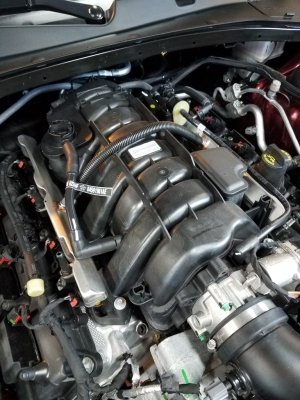
Wow, I was expecting some feedback on Catch cans surely someone must have some thoughts or opinions pro / con
I wasn't going to say anything because catch cans are not the hill I want to even fight on.
I am no car/engine guru,
but I am old enough to remember owning cars that simply vented the PVC gases out into the atmosphere and oil dripped onto the street.
That is a big no-no these days, so my understanding is that it is piped back into the engine for environmental reasons.
I have one on my 2012 Ram 1500 5.7L pickup, and I may be wrong, but I think it helps two things.
1) on my truck the PCV line goes directly into the throttle body, so it seems to keep the throttle body cleaner.
-perhaps that is just my imagination.
2) My understanding is that introducing a fine mist of oil into the fuel will lower the octane rating.
I have often wondered if this is the reason that my owners manual recommends using 89 octane (midrange) gas vs. regular 87 octane to prevent knock, especially when towing.
I have always run a catch can on this truck, and always used regular and mostly use the truck for towing our boat and have never experienced any knock.
Do the other fluid systems have warning lights: Oil, Trans fluid, glycol overheat, washer fluid, brake fluid, TPM,
Those cars with a catch can if they allow the can to fill and all that fluid ends up in the intake at one time will quickly realize they have a problem because the engine will shut down and they will have quit a problem now with oil and gas pooled in all cylinders.
Actually, over on the RAM forum, someone forgot to empty their catch can, it filled up and his truck simply died.
He emptied the can, and was on his way. It did not cause any major disruption. He said it was mostly embarrassing.
My own experience early on was that I was afraid to over-tighten it, the bottom part unscrewed itself, fell off and my CEL came on.
I looked under the hood and found the catch can wedged between the frame and some wiring...
I screwed it back on and was on my way.
yes, but the piston does not come up to the top of the cylinder walls, and the oil ring is still further down on the piston. The top of the piston and the top of the cylinder walls need to cool as well.
The gas that is allowed into the cylinder along with the unspent fuel / air and oil vapour mixture is what cools it just before it is ignited again. To prevent the piston from blowing a hole in it from the combustion explosions every 3rd revolution.
So to answer your initial question ? Yes.
To take the logic from the line if Chrysler felt it was necessary they would have put one in makes perfect sense since they designed and put in oil squirters to squirt oil on the lower skirt of the pistons and underside of Piston tops, because they felt that the piston needed additional cooling to prevent premature failure.
This makes it sound like installing a catch can is actually detrimental to the health of the engine, robbing it of vital lubrication.